
Gwinnett County Superior Court
Georgia does not use a county "District Court" label for Gwinnett's main trial court. The State Court Structure Map for this project identifies Superior Court as the primary trial court and keeps `district-court.html` only as the existing target filename. Gwinnett County belongs to the Gwinnett Judicial Circuit, and Superior Court is the court of general jurisdiction for the county's highest-volume and most serious trial-level matters.
Superior Court has broad civil and criminal authority. It handles felony cases prosecuted by the District Attorney, divorce, adoptions, title-to-land matters, equity, declaratory judgments, habeas corpus, mandamus, quo warranto, prohibition, and review of some lower-court errors. It also fits within a broader local system that includes State Court, Magistrate Court, Probate Court, Juvenile Court, Recorder's Court, and municipal courts.
The Gwinnett Superior Court page is the official local source for Superior Court jurisdiction and court information. It anchors the county trial-court record path for felony, divorce, adoption, land-title, and other Superior Court case categories.
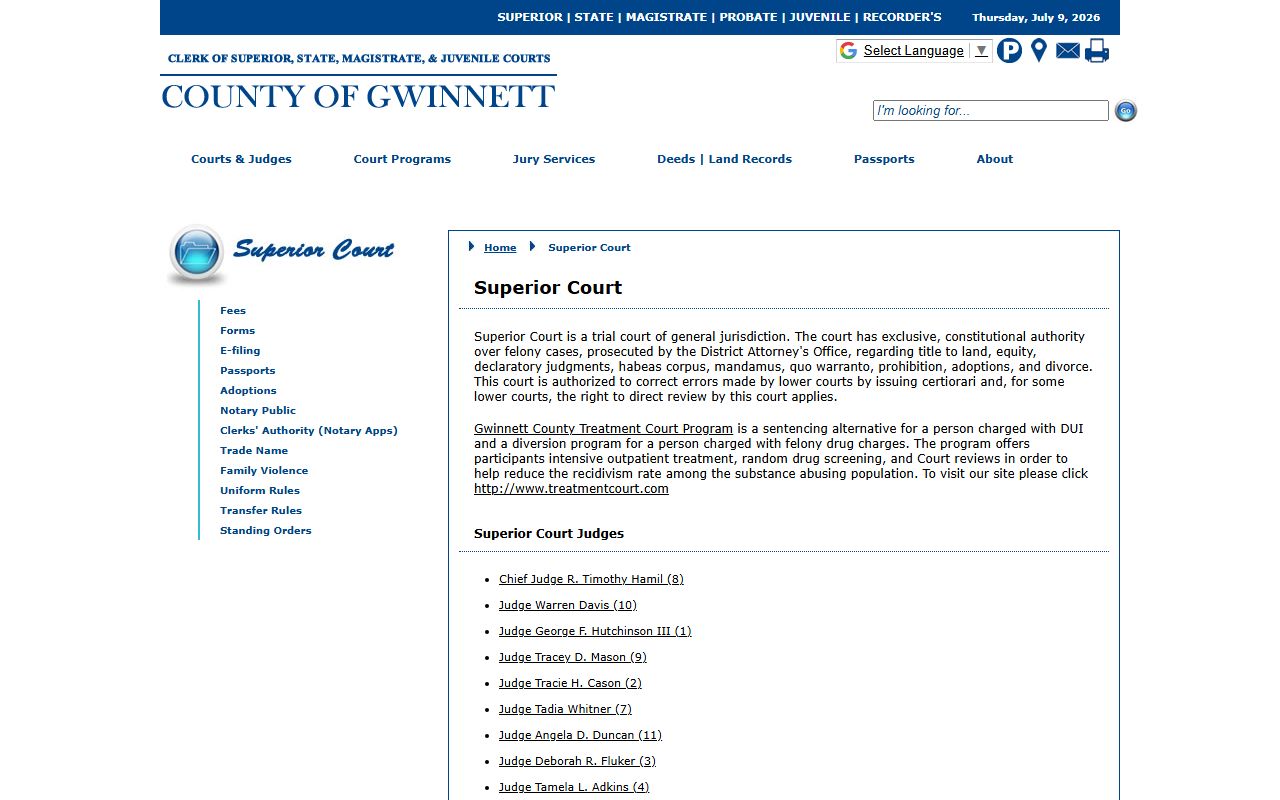
The Superior Court source confirms why the retained District Court page should be read as Gwinnett County's primary trial-court page.
Gwinnett County Court Hierarchy
Gwinnett County court records depend on the court that owns the case. The main court and clerk record location is 75 Langley Drive in Lawrenceville. Recorder's Court and Juvenile Court use 115 Stone Mountain Street. The jail, Sheriff's Office, and Magistrate criminal functions use 2900 University Parkway. Sending every record request to one address can route a user to the wrong counter.
| Court / Office | Type | Address | Phone |
|---|---|---|---|
| Superior Court | Primary trial court for felony, divorce, adoption, land title, equity, and broad civil matters | 75 Langley Drive, Lawrenceville, GA 30046 | 770-822-8100 |
| State Court | Misdemeanor and state-court civil matters | 75 Langley Drive, Lawrenceville, GA 30046 | 770-822-8100 |
| Magistrate Court Civil Division | Civil claims of $15,000 or less, dispossessory, distress warrants, civil calendars | 75 Langley Drive, Lawrenceville, GA 30046 | 770-822-8100 |
| Magistrate Court Criminal Division | Arrest and search warrants, preliminary hearings, criminal calendars | 2900 University Parkway, Lawrenceville, GA 30043 | 770-619-6720 |
| Probate Court | Estates, wills, guardianships, marriage licenses, vital records, weapons carry | 75 Langley Drive, Lawrenceville, GA 30046 | 770-822-8350 |
| Juvenile Court | Delinquent, unruly, dependent, and runaway matters under age 17 | 115 Stone Mountain Street, Lawrenceville, GA 30046-6900 | 770-619-6300 |
| Recorder's Court | County traffic citations and county ordinance cases | 115 Stone Mountain Street, Lawrenceville, GA 30046-6900 | 1-877-794-0988 |
Superior Court vs Lower Courts
Gwinnett County does not have a Texas-style county court or justice court split. The practical comparison is Superior Court against the lower and special courts that handle narrower case classes. Magistrate Court is important for small civil cases, dispossessory matters, arrest and search warrants, preliminary hearings, and no-jury proceedings. Recorder's Court is the local traffic and ordinance court.
| Issue | Superior Court | Magistrate Court | Recorder's Court |
|---|---|---|---|
| Civil scope | Broad civil jurisdiction, equity, land title, declaratory judgments, and divorce | Civil claims of $15,000 or less, dispossessory, distress warrants, and related matters | County ordinance cases within Recorder's Court jurisdiction |
| Criminal scope | Felony cases and serious trial-court matters | Warrant applications, preliminary hearings, and criminal first-stage functions | Traffic citations and ordinance violations punishable by less than six months in jail |
| Family or youth matters | Divorce, adoptions, and some review or related matters | Limited by statute and case type | Not the general family court |
| Record search path | Gwinnett Courts case search, clerk, or counter | Gwinnett Courts case search or Magistrate clerk contact | Recorder's Court public case search and court contacts |
The Gwinnett Magistrate Court page confirms the civil-claim limit, warrant role, preliminary-hearing role, and no-jury-trial rule for Magistrate Court.
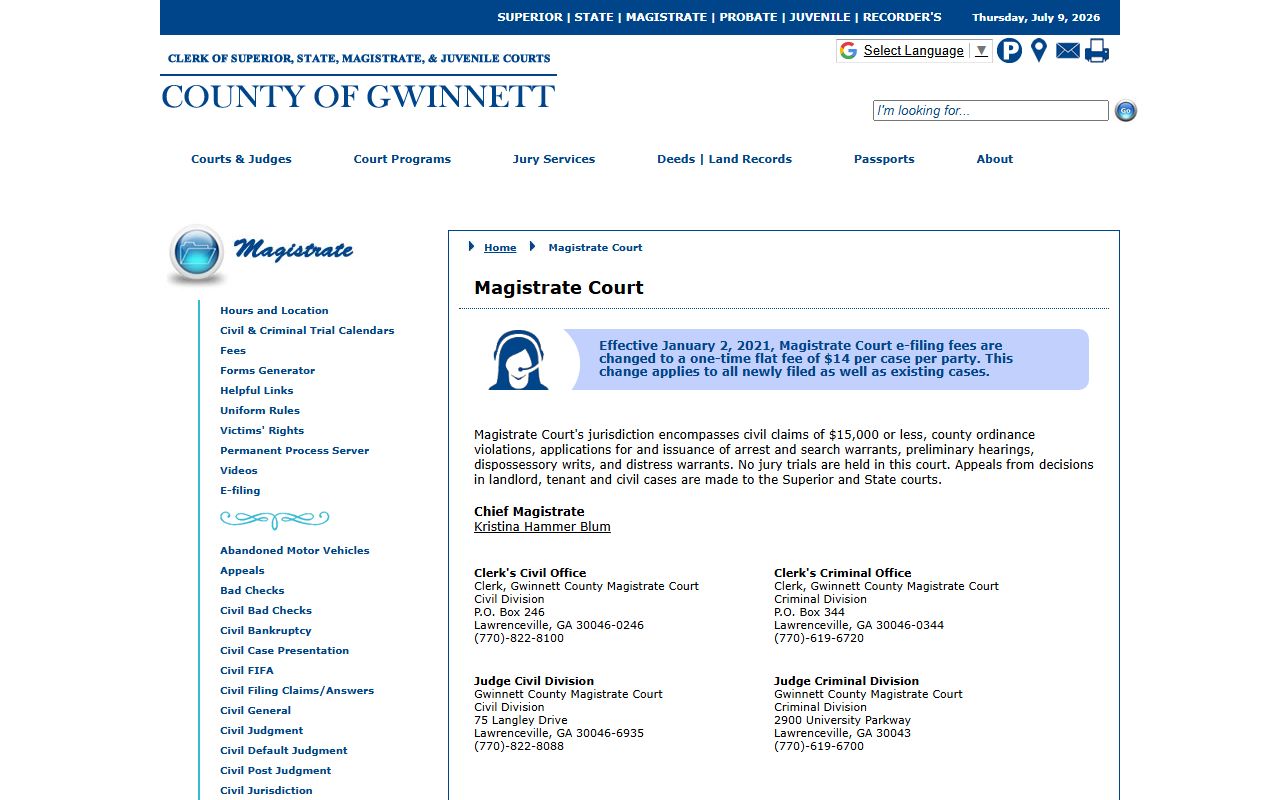
Magistrate Court is a lower court, but its criminal and warrant functions make it essential for court-record routing.
Gwinnett County Case Flow
A case can move through more than one Gwinnett County court. A criminal matter may begin with arrest, booking, warrant activity, or first appearance before later moving into State Court or Superior Court. A civil matter starts with a filing in the court that has jurisdiction over the claim. Traffic citations usually stay in Recorder's Court unless the matter becomes a broader criminal case.
Criminal flow: Arrest or citation › Magistrate or Recorder's Court first stage › accusation or indictment when required › arraignment › pretrial hearings › plea or trial › disposition and sentence › appeal.
Civil flow: Complaint or petition filed › service › answer › motions or mediation › hearing or trial › judgment › post-judgment action or appeal.
Note: Juvenile, adoption, guardianship, and sealed criminal matters can have restricted access even when the court name is known.
Gwinnett County Trial Divisions
Superior Court is central for felony and high-authority civil matters, but Gwinnett County spreads public records across several courts. State Court handles misdemeanor and civil matters outside Superior Court. Probate Court handles estates, wills, guardianship, marriage licenses, vital records, weapons carry, and involuntary hospitalization proceedings. Juvenile Court handles delinquent, unruly, dependent, and runaway offenses under age 17, with confidentiality limits that do not apply in the same way to many adult records.
The official Georgia court structure guide describes Georgia's appellate courts and trial-level courts. That state source supports the local point: Gwinnett County court records should be organized by Georgia court class, not by a county District Court label.
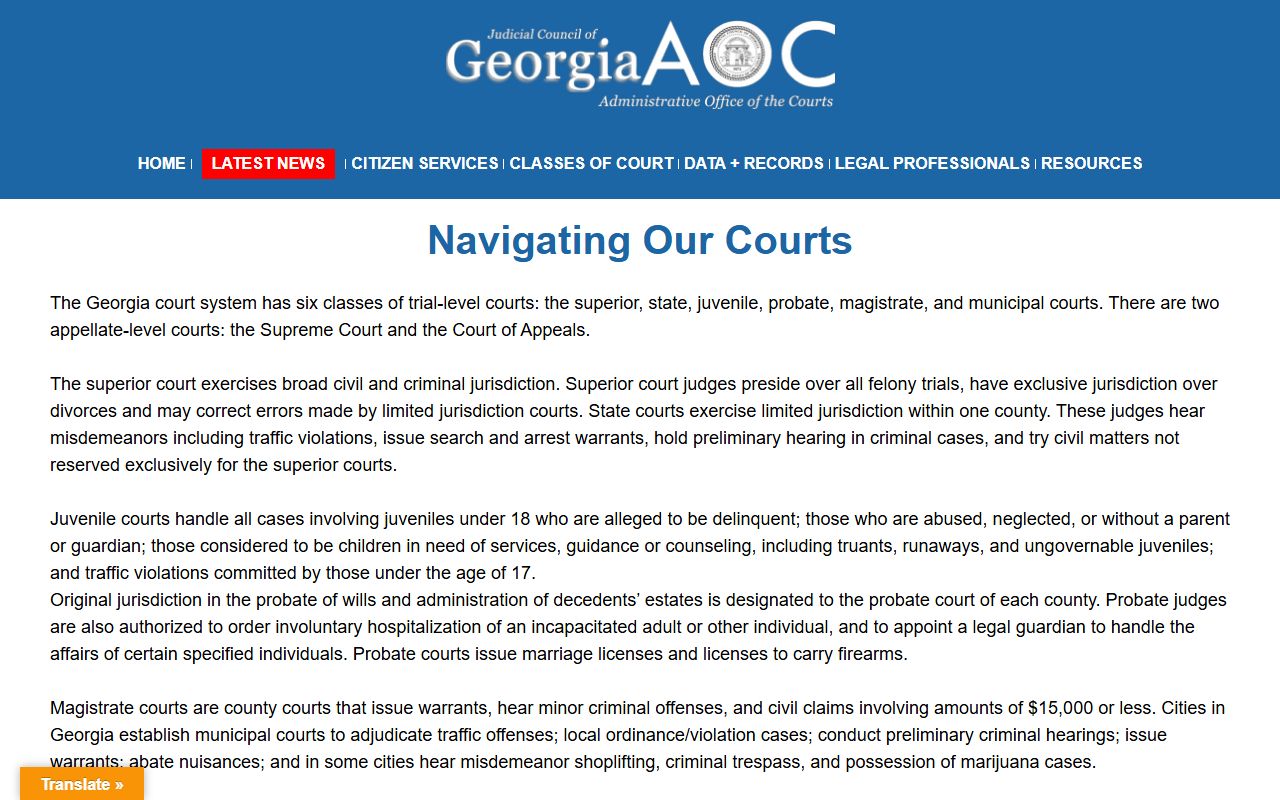
The state guide helps distinguish Superior, State, Juvenile, Probate, Magistrate, and Municipal courts for Gwinnett County searches.
Gwinnett Judicial Circuit
Gwinnett County is its own Gwinnett Judicial Circuit for Superior Court purposes in the research map. The local court system is centered at the Gwinnett Justice and Administration Center at 75 Langley Drive for the main court and clerk functions. The Gwinnett Courts official site links the court pages, case search, clerk services, traffic payment, jury service, and courthouse information. The Clerk of Court serves Superior, State, Magistrate, and Juvenile courts, while Probate Court and Recorder's Court have their own operations for their case types.
Specialty court programs also connect to the trial court structure. Gwinnett County accountability court programs include Drug Court, DUI Court, Mental Health Court, Veterans' Treatment Court in State Court, and Veterans' Treatment Court in Superior Court. Drug Court is described as a five-phase Superior Court level intervention program for adults accused of crimes and struggling to maintain sobriety.
Federal District Court Distinction
Federal district court is different from a county trial court. Gwinnett County falls in the Atlanta Division of the U.S. District Court for the Northern District of Georgia. The Atlanta federal courthouse is in Atlanta, and the Northern District uses CM/ECF and PACER for federal case access. Federal criminal prosecutions, federal civil rights suits, federal-question cases, diversity cases, bankruptcy-related federal systems, and federal habeas matters are not Gwinnett County Superior Court records.
The Northern District of Georgia website is the official federal source. Federal cases should not be searched through the county clerk as if they were Gwinnett County Superior Court cases.
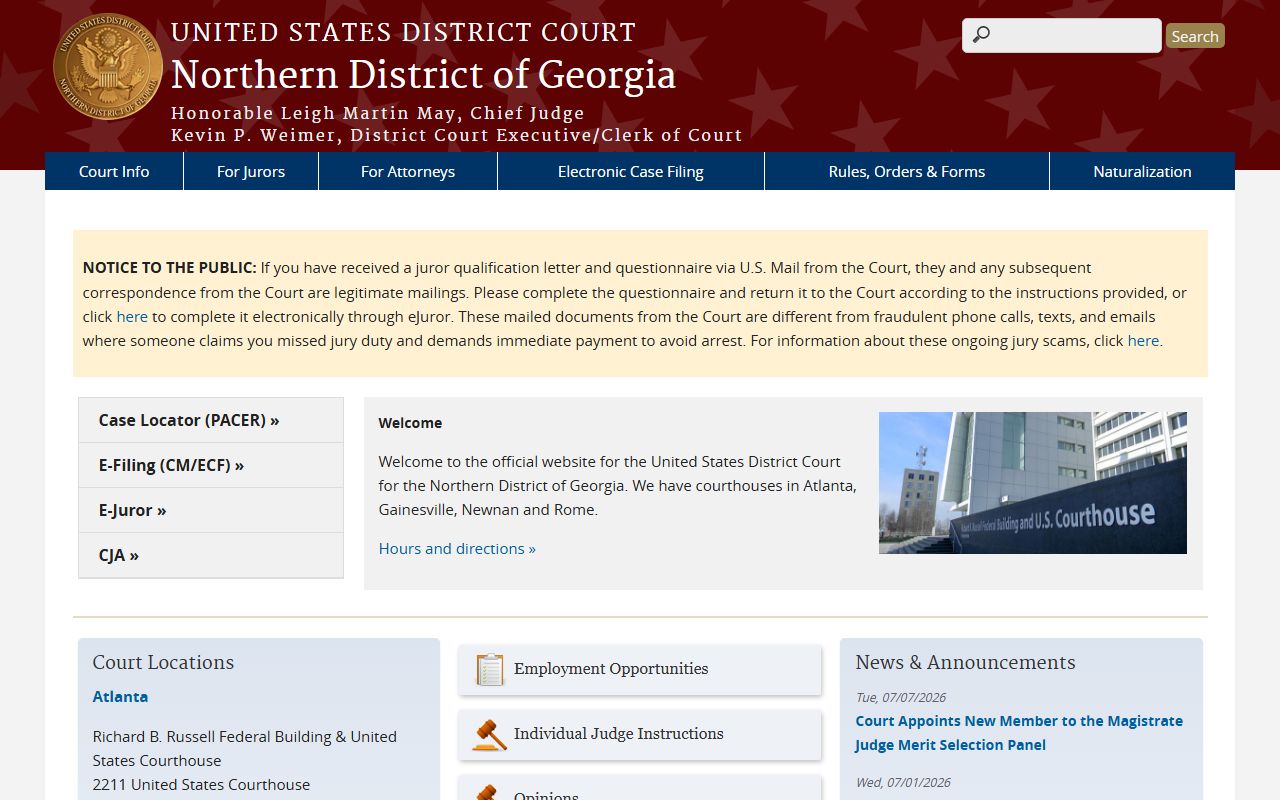
The federal source reinforces the key distinction: federal district court records and Gwinnett County trial court records use different offices and databases.